rgb / cmy
the color wheel
|
|
|
the color wheel |
|
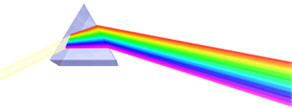
What looks like ordinary white light, such as sunlight, is actually composed of a multicolored band of light, known as the visible spectrum. We see these colors when light passes through a prism, or when it is broken up by water droplets in the sky, creating a rainbow.
|
 |
|
| Isaac Newton was the first person to discover that white light contains these multicolored hues, and proved it in 1665 by using a second prism to turn the rainbow back into one beam of light. Try Newton's experiments yourself! | 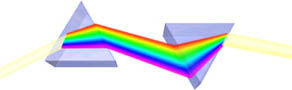 |
|
|
The colors of the visible spectrum are: Red, Orange, Yellow, Green, Blue, Indigo, Violet, always appearing in this order. An easy way to remember this is by remembering ROY G. BIV - his name spells out their initials. Newton was the first person to draw these colors as a wheel. His diagram is at right –> There are really an
infinite number of colors, filling in all the areas between the points
for which we have names. Roll your mouse over the color
wheel below. 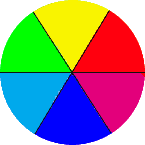 |
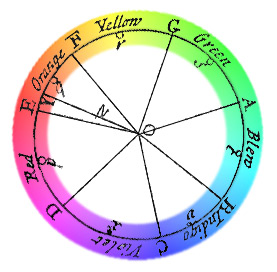 Isaac Newton's original color wheel drawing. |
|
|
In any system of color, primary colors are pure colors that can't be formed by mixing any of the others. When you mix the three primary colors together you either get either white or black, depending on which color "system" you are using. 1) Additive (RGB)
Color: 2) Subtractive
(CMY) Color:
|
||
|
|
|
| class notes | |