
the color wheel
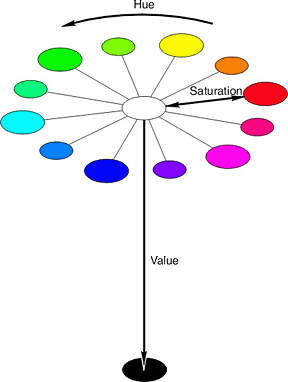
hue, value, saturation
|
|
the color wheel |
|
|
Hue refers to the first word we use when we normally think of color. When we use words such as red, purple, orange, etc., we are describing a color's hue. Value 
We also perceive color differences in two other ways. One is a color's lightness or darkness. We can refer to this as lightness-darkness, brightness, or its value. A color's value can be changed by adding either white or black. Colors also have an instrinsic relative value at full saturation (the outer edge of the circle at right). Yellow, for example, has a lighter color value than any other color at full saturation.
Saturation Saturation refers to the dominance of hue in the color. A color's saturation changes as white is added to it. In the diagram, on the outer edge of the color wheel are 'pure' hues. As you move toward the center, the hue dominates less and less. When you reach the center of the wheel, there is no hue, only white. The colors on the central axis are desaturated and represent the grayscale - a continuum of grays running from white to black. |

|
|
Experiment changing color Hue, Value and Saturation yourself!
|
|
|
| class notes | |

